On July 8, the Altai Branch of the Collaborative Research Center for Archaeology of the Silk Roads was officially inaugurated at Altai State University in Russia. This establishment is part of the "China-Russia Year of Education" in 2026, aimed at enhancing cultural exchanges and cooperation in heritage preservation between the two nations. The center will focus on joint archaeological research in the Altai Mountains, a key region for understanding the interaction of Eurasian steppe civilizations.
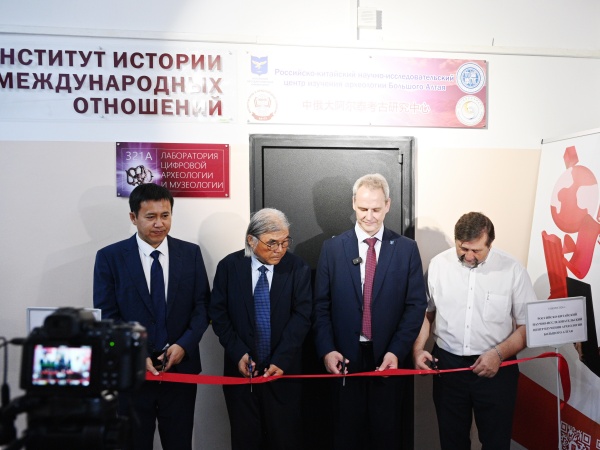
The ceremony was attended by over 20 experts from four countries, including representatives from Altai State University, Kazakhstan's Issyk State Historical and Cultural Museum, the Margulan Institute of Archaeology, the Mongolian Academy of Sciences, and China's Northwest University. The inauguration was led by Altai State University President Sergey Bocharov and Professor Alexei Tishkin, alongside Professors Wang Jianxin and Shao Huiqiu from the Silk Road center. Professor Tishkin was appointed as the Russian Director, while Professor Shao was named the Chinese Director.
President Bocharov emphasized the university's strong background in archaeology and stated that the new branch represents a milestone in China-Russia archaeological collaboration. The university is dedicated to supporting the branch's growth and ensuring successful partnerships.
Professor Shao highlighted the branch's mission to establish a platform for continuous academic exchange. It will promote joint archaeological surveys, cultural heritage protection, and the training of young scholars in the Altai region. The center aims to create a new mechanism for cross-border cooperation among China, Russia, Mongolia, and Kazakhstan.
Professor Wang reviewed the collaborative history with Altai State University and noted the region's significance for studying early nomadic cultures and Silk Road interactions. He expressed optimism for significant breakthroughs in Altai archaeology through multinational efforts.
The Altai Branch is the fourth and second overseas branch of the Silk Road center, following those in Kashgar, Issyk, and Hami. It seeks to enhance archaeological collaboration and research on early nomadic civilizations and Silk Road cultural exchanges, fostering a new paradigm in archaeological studies and training the next generation of cross-cultural scholars.
原文链接:http://education.chinadaily.com.cn/2026-07/09/c_1196367.htm


 Copyright 2025 Northwest University. All Rights Reserved.西北大学版权所有 陕ICP备05010980号-4 陕公网安备 61011602000427号
 校长信箱
校长信箱 信息门户
信息门户 AI服务
AI服务 OA
OA 图书馆
图书馆
 EN
EN


